News & Commentary
Jan 31, 2016
ACLU-VA Joins with Coalition to Fight Blatantly Discriminatory SB40
The ACLU of Virginia and three other prominent civil rights organizations have joined in a strongly-worded letter to state Sen. Mark D. Obenshain (R-Harrisonburg), chair of the Senate Courts of Justice Committee, urging opposition to Senate Bill 40."If passed, this bill would allow all clerks and deputy clerks in the commonwealth to refuse to issue a marriage license to any couple if the clerk objects to the marriage based on 'personal, ethical, moral, or religious grounds,'" according to the letter, signed by ACLU-VA Executive Director Claire Guthrie Gastañaga, Americans United for Separation of Church and State State Legislative Counsel Amrita Singh, Anti-Defamation League Associate Regional Director Eric M. Wachter, and Jewish Community Relations Counsel of Greater Washington Director of Virginia Government Relations Darcy Hirsch.The letter continues: "If this legislation is passed and signed into law, clerks would believe that they could refuse to issue marriage licenses because they do not approve of marriage for couples who are interfaith, interracial, same sex, or divorcees. Government officials—funded with taxpayer dollars—should not be allowed to pick and choose which of their duties they will fulfill or which services they will provide and to whom, especially when the result would be blatant discrimination and the service to be denied involves a fundamental human right."Fundamental reasons why SB 40, sponsored by Sen. Bill Carrico (R-Grayson) should be defeated are:
Jan 27, 2016
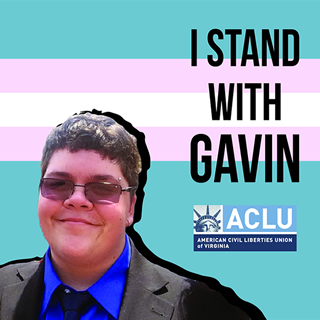
Gavin Grimm Statement Regarding School Sex Discrimination Lawsuit
Following is a prepared statement that Gloucester High School student Gavin Grimm delivered at a news conference today with his attorneys from the ACLU of Virginia and ACLU national. The conference was held immediately following oral arguments before the U.S. Court of Appeals for the Fourth District in Gavin's sex discrimination case against his local school board. Watch the entire news conference below."Standing at the school board meeting last year was equal parts humiliating and terrifying."Humiliating because, at age 15, I had to witness adults of my community discuss in a public forum some rather intimate details of my anatomy. In plainer words, the anatomy of a 15-year-old was considered appropriate for public conversation by the Gloucester County School Board."For any kid that would be mortifying. However for a kid who is transgender, bringing to the forefront of people’s minds the very part of themselves that already makes them dysphoric is incomparably distressing."I sat by while people repeatedly called me a girl. "She." "Her." "Young lady." "Confused young lady." Even "freak." Bullying is already an enormous problem for high school aged youth, and especially transgender youth. To hear adults of my community treat me as if I was a creature for their ridicule and observation, or some oddity on a stage was incredibly dehumanizing to an extent I could not possibly convey."And of course, I was terrified. Firstly, because the school board had the power to bar me from the correct restroom for the rest of my time at Gloucester High School. Secondly, because I was in a room full of adults who thought it appropriate to have this sort of vulgar discussion, who would clap or cheer after every derogatory statement, of which there were many."After enduring all of that – twice – I felt as though I couldn't possibly take any more hits. But I did, because at the end of the school board meetings, my school board chose to enact a policy that would further alienate and stigmatize me by forcing me to use separate restrooms from all of the other students at school. For me, the thought of going into a separate restroom which might as well have been labeled "other" was just far too much to bear. The trek to the restroom in the nurse’s office each time it was necessary was similarly humiliating, similarly upsetting and othering and dysphoria-inducing. The only difference was that it was just slightly less conspicuous."I am fighting this fight because no kid should have to think so hard about performing a basic and private function of being alive. No kid struggling to be accepted, and struggling to accept themselves, should have to simultaneously battle for the right to use the correct bathroom. That is why I have come to this point. I hope that I will be one of the last kids that has to go through something like this, and I am going to do what I can to ensure that."
Jan 25, 2016
Anti-LGBT Laws Would Dial Back Progress in Public Schools
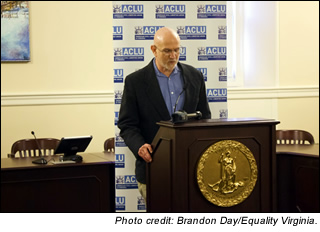
Note: This is the first in a five-part series featuring Virginians whose rights would be directly affected by anti-LGBT bills now under consideration in the state legislature. All writers participated in a joint news conference held by the ACLU of Virginia and Equality Virginia at the Virginia Capitol on Jan. 19, 2016.By Robert Rigby Fairfax County Public Schools (FCPS) PrideI have been a teacher in the Fairfax County Public Schools district for the past 17 years. I represent a new employees’ group, “FCPS Pride.”After many years of efforts, Fairfax County updated its non-discrimination policies during the past school year to include sexual orientation and gender identity. As a result, we were able to organize as a certified employees’ group, to include lesbian, gay, bisexual and transgender staff of FCPS. We are teachers, administrators and sponsors of student clubs; we have been joined by parents of LGBT students in Fairfax, and community members.FCPS Pride was disappointed but not surprised by Del. Bob Marshall’s (R-Manassas) House Bill 385, which would prohibit school boards and state agencies from passing inclusive non-discrimination policies, which protect LGBT staff, families and students.Members of the LGBT community of staff in Fairfax, my community, have spoken of the acceptance we sense in our schools as a result of the passage of the inclusive policies. I and others feel more secure in our employment than we ever have. New teachers talked about coming to Fairfax in part because it is a welcoming employer. Marshall’s bill would dial this all back; he would take away our sense of security and inclusion.These bills will affect the ability of public schools to attract employees and families, and will also impact colleges and universities in bringing in professors and students. It will make Virginia a less attractive place to live and work. As for Del. Mark Cole’s (R-Fredericksburg) bills to limit and penalize bathroom use based on “anatomical gender” (HB 663 and 781), our response is one of disbelief and anger.Cole says that he expects his proposal to be enforced by facilities users. I imagine suspicion of students, staff and visitors, perhaps resulting in accusations, and some sort of hearings and assessment of a person’s gender.As teachers we wonder whether we would be called upon to enforce this law; if a student or a visitor brings a complaint to me, do I refer it to my assistant principal, do I contact our School resource officer? Will I need to defend myself if someone brings a complaint against me? It brings in worry and anxiety not only to transgender stakeholders in our schools, but to anyone who may not meet some “user’s” concept of masculinity or femininity.What he calls “common sense” legislation in fact ramps of the rhetoric around these concerns, and increases fear in our schools.
Oct 16, 2015
Advocating for Virginia's Public School Students
The ACLU of Virginia recently sent the following letters to school divisions regarding important rights issues affecting students. -- Equality for LGBT Students:On October 8, 2015, the ACLU of Virginia sent a letter to all Virginia public school superintendents to raise awareness and bring attention to reports of harassment against students in Virginia schools who are, or are perceived to be, lesbian, gay, bisexual, or transgender (LGBT). In the letter, we remind superintendents of the district's legal responsibility to investigate every alleged case of bullying and to take appropriate actions to prevent bullying. -- Challenging Sex Discrimination in Schools:The ACLU of Virginia on October 13, 2015, sent a letter to the Chesterfield County School Board urging the school board to revise its dress code policy, which has ambiguous and vague language, and is administered in a way that disproportionately targets female students for violations. -- Free Expression in Schools:The ACLU of Virginia on October 13, 2015, sent a letter to Christiansburg High School regarding its prohibition on confederate flag emblems in the parking lot and on student clothing. We asked administrators for the rationale for their policies and urged them to review those policies to ensure that they do not infringe on students' rights to free expression.
May 19, 2015
The Good and the Bad of the 2015 General Assembly Session
It’s a wrap. After four months of advocacy before the General Assembly and Governor’s office, we can finally report how Virginians’ rights fared during the 2015 General Assembly Session. We had some major victories, but also some disappointing losses.
Stay Informed
Sign up to be the first to hear about how to take action.
By completing this form, I agree to receive occasional emails per the terms of the ACLU’s privacy statement.
By completing this form, I agree to receive occasional emails per the terms of the ACLU’s privacy statement.