
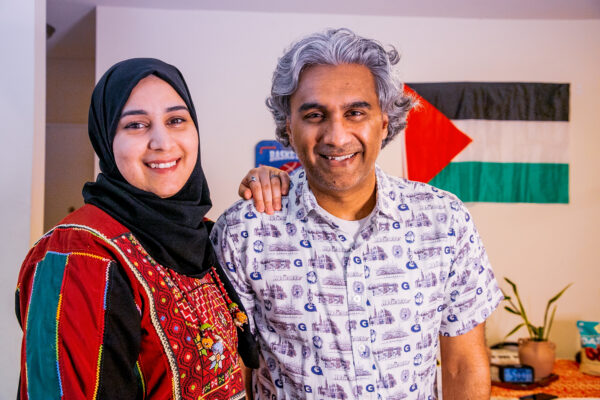
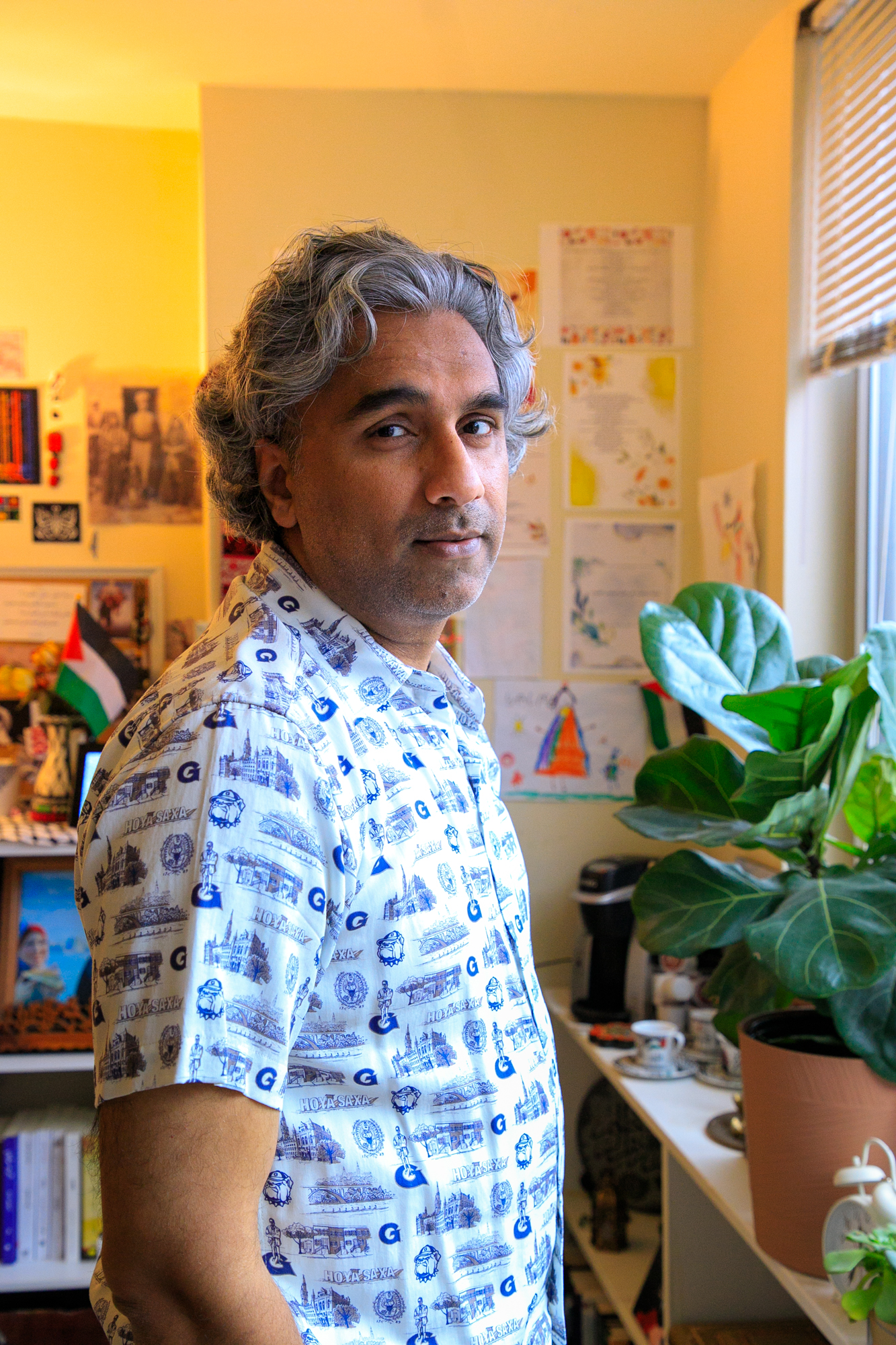
Badar wears his Georgetown University shirt with pride. He is the only one in his family who has a doctoral degree or moved to America.
Photo: Phuong Tran
Dr. Badar Khan Suri arrived in the U.S. in 2022 for a postdoctoral fellowship at Georgetown University. He was full of dreams – for himself as a scholar studying religion and peace, and for his family, who would start their life in America, the “land of the free.”
But Badar's quiet life with his wife and three children in Rosslyn, Virginia was thrown into chaos on March 17, 2025. As he was coming home after iftar, a traditional Ramadan meal celebration, masked federal agents accosted him outside his apartment.
In just over 72 hours, Badar was shuttled to several locations across three states, ultimately landing in Prairieland Detention Center in Alvarado, Texas, where he was detained for almost two months.
I was so excited to go to America. It has the best freedom of expression and a great Constitution that guarantees you your First Amendment rights.
Like Mahmoud Khalil, Rümeysa Öztürk, and Mohsen Mahdawi, Badar is one of multiple international students and scholars whom ICE has illegally targeted in retaliation for constitutionally protected speech. Badar was targeted because of his Palestinian wife, a U.S. citizen, and because he spoke out in support of Palestinian rights.
Badar exercised his freedom of speech, and he was punished by our government. Here’s his story.
Who is Badar Khan Suri?
I am a researcher who did my PhD in peace and conflict in India, [where] I was born and grew up. I am a student of politics. I wanted to have a better understanding of society. As a researcher, I study that, and as a human being, I try to navigate through that.
Outside of my work, I am a son of great parents. I am a sibling. I am a husband. I am a father of three kids. I am a teacher at Georgetown. I carry many identities. I am a son, brother, father, husband, friend, scholar, and a member of society. I am a practicing Muslim. I respect all faiths – not just Abrahamic ones, but all religions.
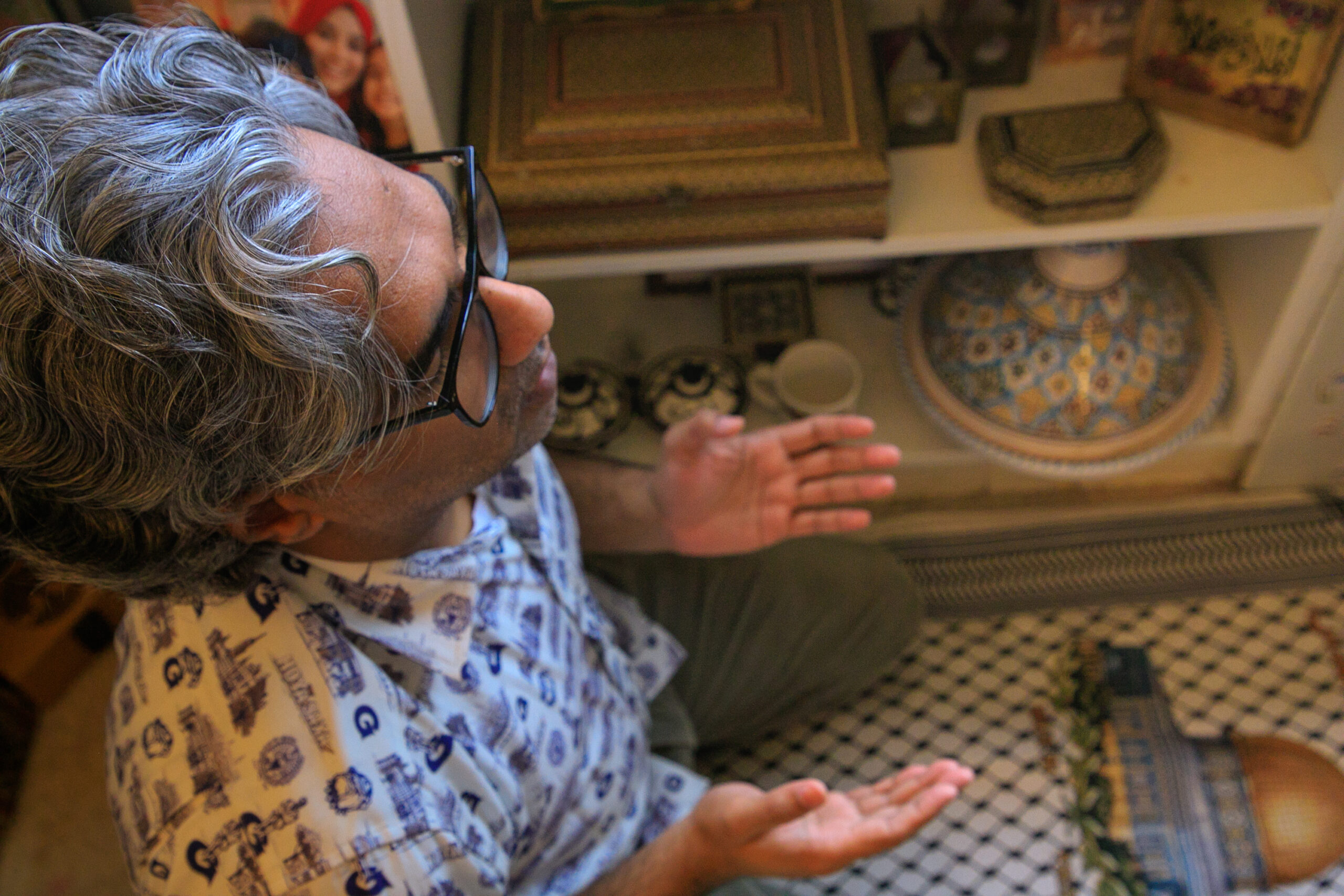
Badar prays in his living room as he observes Ramadan.
Photo: Phuong Tran
What are your hopes and dreams when you came to America?
I was so excited to go to America. It has the best universities in the world. It has the best freedom of expression and a great Constitution that guarantees your First Amendment rights. I am proud of the institution I am in, the freedoms I have here, and the collegiate network I have. I am surrounded by the greatest students, whom I am able to teach, share knowledge, and learn from them. It was a dream come true to come here to Georgetown University. I was living my best life.
What do you study?
I study totalitarianism in the Middle East and South Asia and how state governments become totalitarian regimes. And then I realized totalitarianism is happening in America as well.
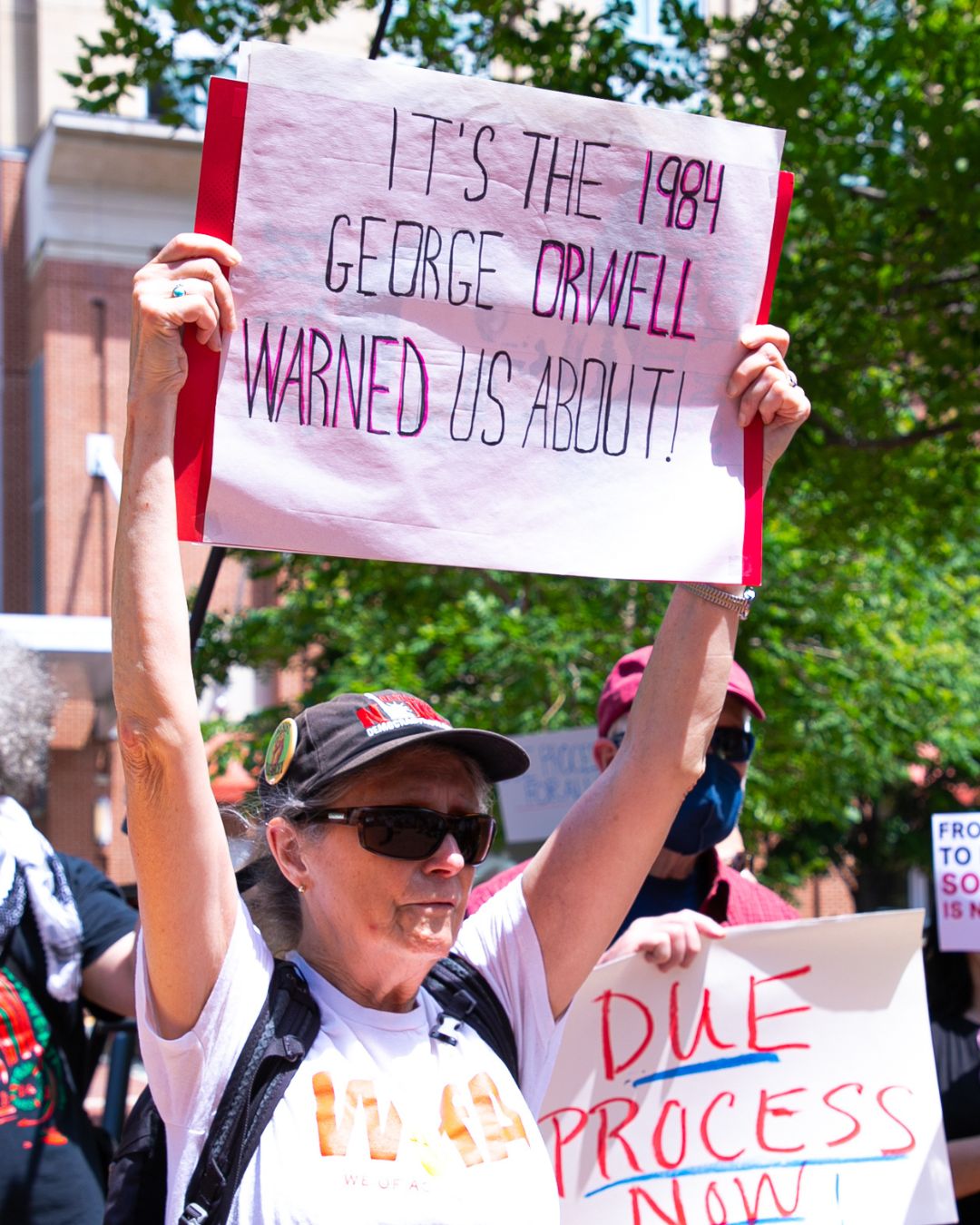
A protester holds up a sign referencing George Orwell's 1984 at a rally to demand Badar's release from detention.
Photo: Phuong Tran
Not only did I see it, I experienced it. I was picked up and transported to different detention centers without being able to let anyone in my family know. I was like an Amazon package, shipped from one place to another. For several days, I didn’t know what was happening to me.
It dawned on me that you can be disappeared like this in a “first world” country, in the United States of America – stories that we only read about in George Orwell’s 1984.
And yet, that happened here to me while I was only doing my research. It happened to five-year-old Liam Ramos. It happened to so many people I saw while I was in detention.
It dawned on me that you can be disappeared like this in a “first world” country, in the United States of America – stories that we only read about in George Orwell’s 1984.
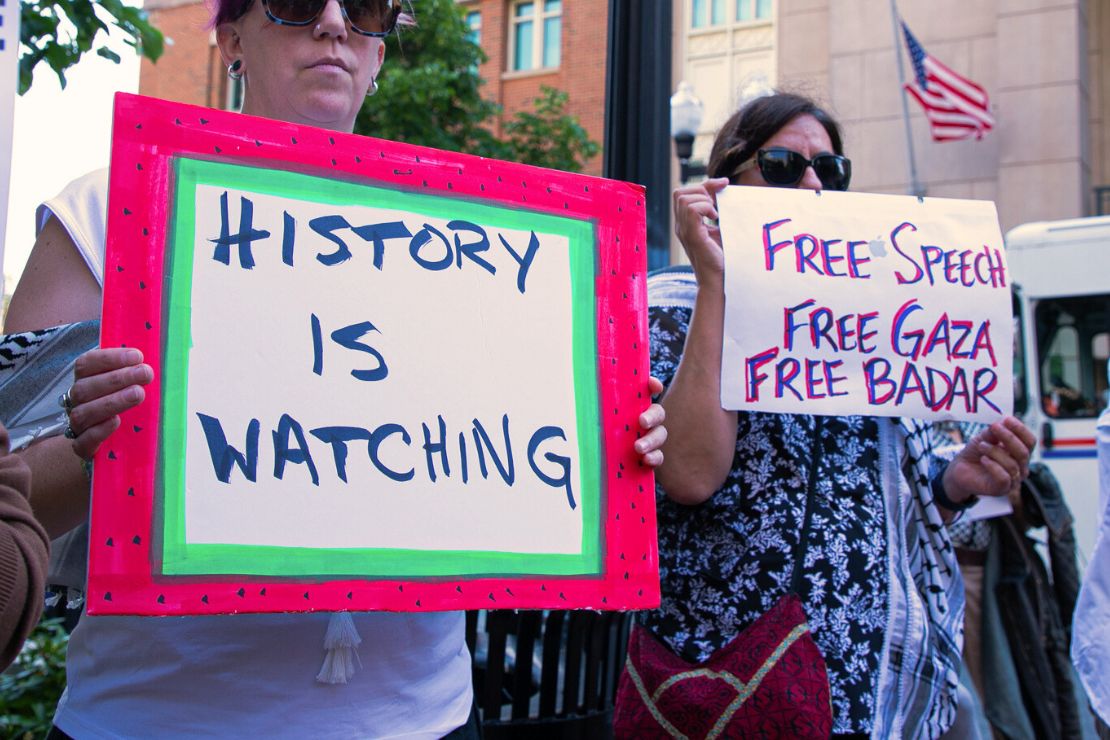
Community members show up for Badar and our First Amendment rights.
Photo: Phuong Tran
What breaks your heart?
Seeing kids like Liam in detention breaks my heart, and there are many Liams here.
When I was in detention center, I saw people suffering. They were taken away from their families. And that was happening in America ... breaking up families and doing grave injustice to humanity, where being seen as human became a privilege and where our dignity is conditional.
Seeing kids like Liam in detention breaks my heart, and there are many Liams here. Seeing that 20,000 kids in Palestine died breaks my heart. Seeing Renee Good being shot breaks my heart. She was only saying “I’m not mad.” Alex Pretti was a nurse, and he was shot, for what? He was there to protect immigrants. It is unimaginable.
All of this breaks my heart.
What gives you hope?
When I saw the support from all the people who came to help me — thousands of them — I feel hope. When I see people from everywhere in America coming out in support of immigrants and against the brutal policies of the government, such as in Minnesota, that gives me hope. The beautiful society and civil liberties organizations like the ACLU give me remarkable hope.
When I saw the support from all the people who came to help me — thousands of them — I feel hope.
I love America a lot – the system, the society, and the people. Every country has its own issues, but I am so happy that my kids get to go to school here and bond with the community here. America was built by immigrants. There’s so much diversity and multiculturality here.
Last year, my kid, who was 5 years old, came to me a week before Ramadan to share that his teacher said Ramadan was coming. That moment reminded me that while America is a Christian-majority country, there’s still respect for other religions. It’s not just a right in the Constitution, but the schools and the teachers are teaching kids to respect religious diversity. I am very happy that my kids are in the U.S. and that they are having these experiences. It’s great to live in a diverse society.
America was built by immigrants. There’s so much diversity and multiculturality here.
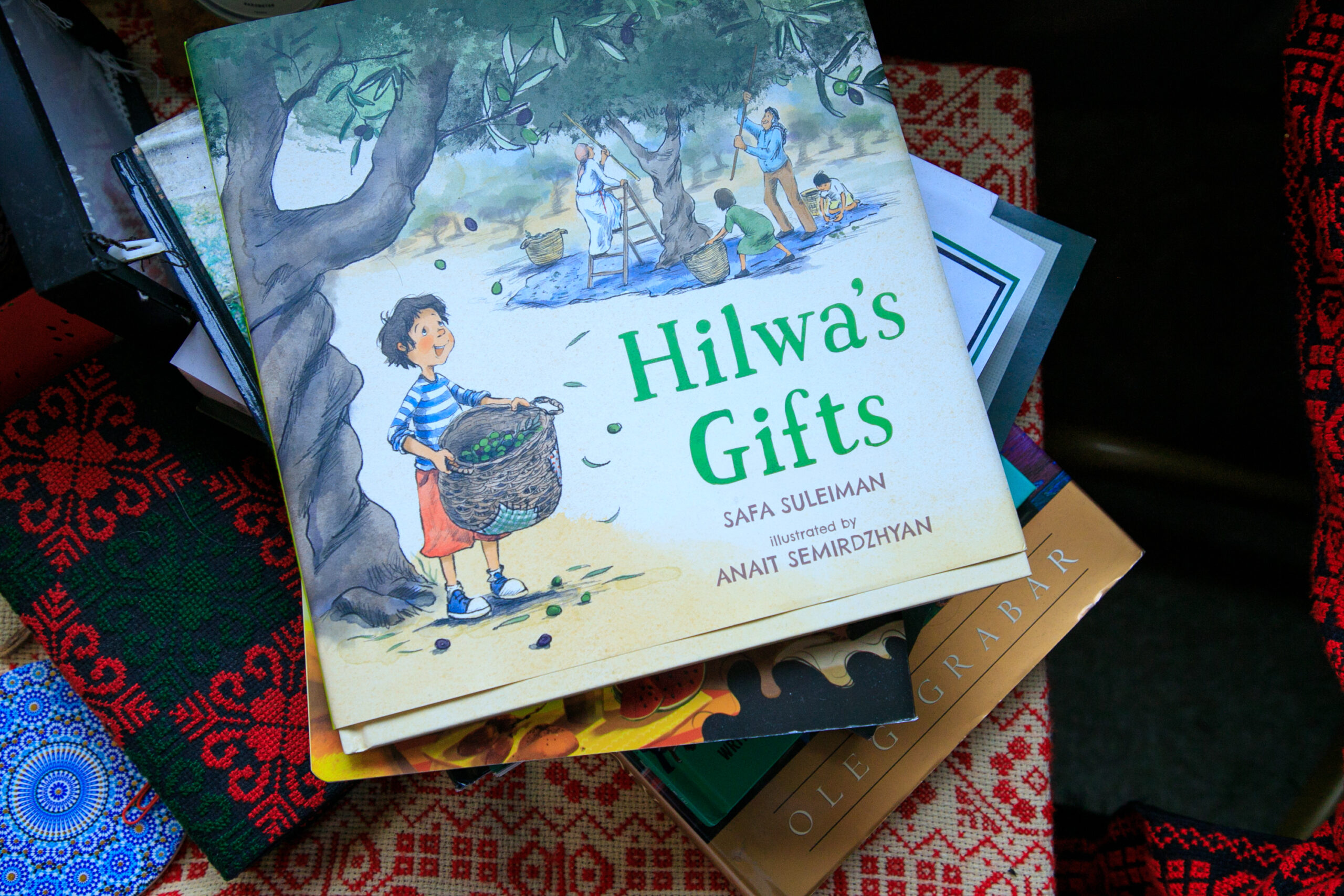
One of the children's books that Badar's kids are reading, Hilwa's Gifts, sits on the table.
Photo: Phuong Tran
Who are your community?
When I first came to America, I came alone with nothing but my suitcases. I had no friends, and I only knew my professor. Then my wife and my kids came over. We would go to the mosque at Georgetown University and attend different chaplain programs to learn about different religions. My son once came with me to a Hanukkah event, and the rabbi taught him a top game. From my students to the families of my kids’ friends, Georgetown University is my community.
Then I was detained by ICE, and the true colors of this very rich and beautiful society became clear to me.
Then I was detained by ICE, and the true colors of this very rich and beautiful society became clear to me. Everyone reached out to us. When I was in a detention center, they took care of my family. Every day, someone would take my kids out for a drive, to a park, or to an ice-cream shop. They were going through a hard time, but they were always with someone. It was not just that people were nice and kind. It was beyond that.
Had I not been through this experience, I would not have seen how the community showed up for me and my family.
Some of my students and students at Georgetown University held a benefit concert for me. These students are doing five or six courses or working two or three jobs: they don’t have a single second to waste. Despite that, they arranged five or six bands for the concert and raised money for my legal case. Some of them – every day – are baking and selling cookies [to fundraise for Badar]. This is remarkable. I feel very grateful to everyone’s care and love.
Had I not been through this experience, I would not have seen how the community showed up for me and my family. With this experience, I have had a chance to see many beautiful facets of American society.
What would you like your kids to know about you through all of this?
With time, they will know the truth about what happened to me. I hope they would be proud of their father because their father had a principled position. He talked about Palestine. He protested against genocide and was punished for it. But at least, he didn’t sit on the sidelines and say nothing.
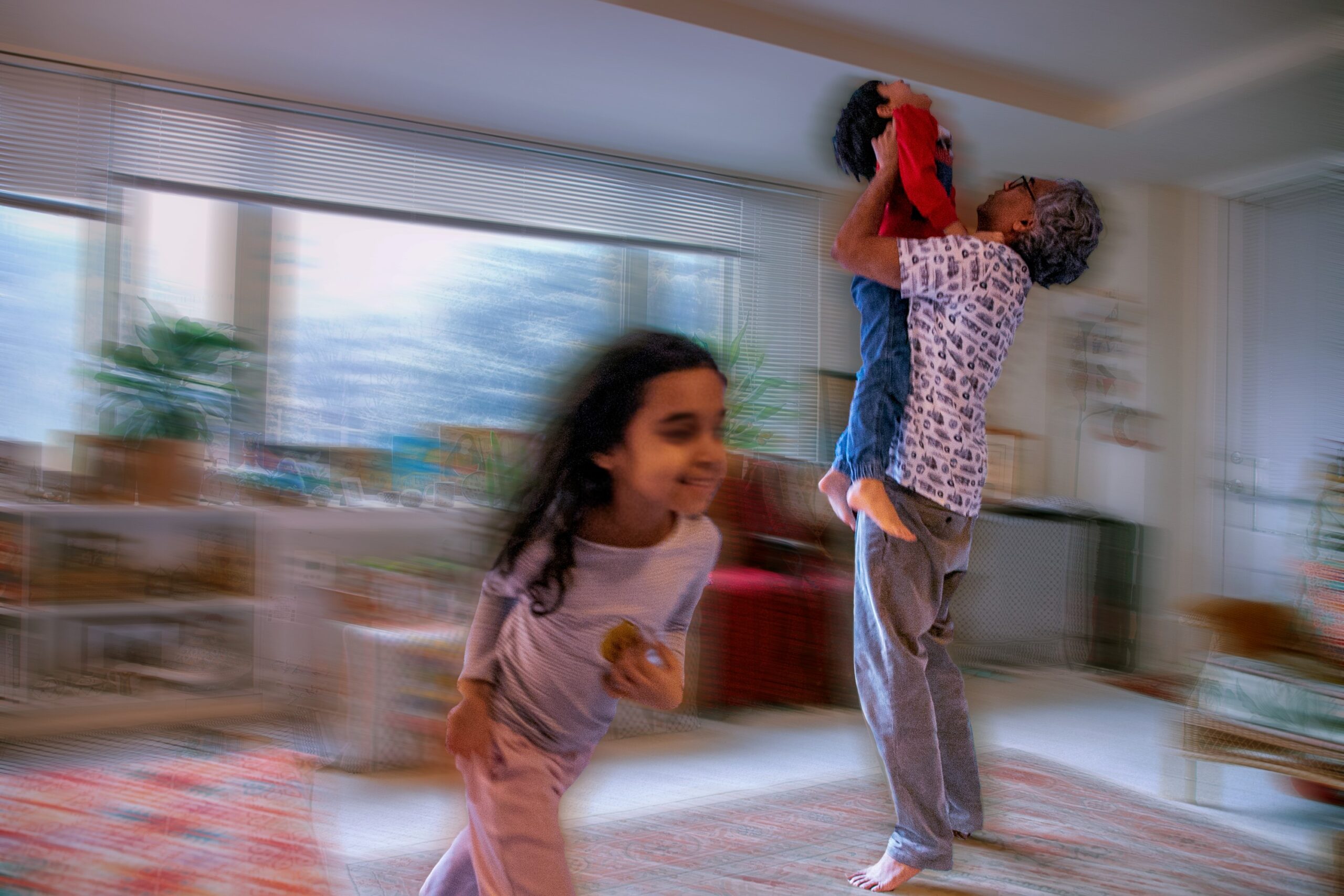
Badar cherishes the time he gets to spend with his kids even more after his experience in ICE detention.
Photo: Phuong Tran