
Federal judge rules Virginia may no longer deny registration for hundreds of thousands of disenfranchised voters
August 20, 2026 4:00 pm

RICHMOND, Va. – A federal judge issued a new order this week in King v. Youngkin, a class action lawsuit filed by ACLU of Virginia, Protect Democracy, and WilmerHale, explicitly ruling that Virginians with convictions for all but 11 specific felonies should be able to register to vote, paving the way for hundreds of thousands of Virginians with felony convictions to finally have access to the ballot box.
“Earlier this year the court ruled that Virginia broke federal law by stripping the voting rights of every Virginian with a felony conviction,” said ACLU-VA Legal Director Eden Heilman. “It is shocking that instead of taking this opportunity to rid itself of a Jim Crow-era scheme that has disproportionately impacted Black voters for more than a century, the attorney general’s office instead created a process that erected new barriers to registration and robbed many newly eligible voters of the opportunity to participate in the August primary elections. As the November general election approaches, the court’s order makes clear once and for all that the Commonwealth cannot deprive hundreds of thousands of eligible voters their right to register and cast their votes.”
King v. Youngkin took aim at Virginia’s practice of permanently disenfranchising every Virginian with any felony conviction, which the Commonwealth adopted in 1876 despite explicit terms in the Virginia Readmission Act forbidding it from doing so. Until the court’s ruling, Virginia was the only state where people with felony convictions are permanently disenfranchised unless they individually petition the governor to have their rights restored, and the governor personally restores their rights.
In January, a federal judge found that Virginia’s felony disenfranchisement scheme broke federal law. Yet even after receiving an extension to the court’s deadline for implementing the decision, the Commonwealth interpreted the court’s order in a way that limited its intended scope and failed to take the necessary steps to ensure that newly eligible Virginians could register.
“For more than six months since the court’s decision in our clients’ favor, Virginians newly eligible to vote have had to guess whether they qualify, complete an outdated voter registration form and navigate a confusing supplemental process,” said Protect Democracy Counsel Jared Davidson. “Today’s ruling makes it clear who is entitled to register to vote and that the state cannot impose a convoluted process before registering qualified citizens to vote.”
The court’s order spells out that the only felony convictions for which Virginians can lose their right to vote are those considered felonies at the time that the Virginia Readmission Act was passed. In 1870, these crimes were: murder, manslaughter, arson, burglary, robbery, rape, sodomy, mayhem, and larceny.
“The Virginia Readmission Act is very clear: Virginia’s Constitution can disenfranchise someone only if they’re convicted of something that was a felony at common law. But since then, Virginians have lost their right to vote due to convictions for crimes no one had even heard of in 1870, like drug crimes, for example,” said Brittany Amadi, Partner at WilmerHale. “Today’s ruling is a significant step towards finally righting this wrong.”
Today at least 300,000 Virginians are disenfranchised due to a felony conviction, disproportionately Black Virginians who make up less than 20 percent of Virginia's voting-age population, yet account for nearly half of Virginians who are disenfranchised due to felony convictions. The court’s order paves the way for hundreds of thousands of Virginians with felony convictions to finally be permitted to register and vote during an election year and at a time when voting rights – especially Black voters’ rights – are under attack nationwide. King v. Youngkin plaintiff Tati King is just one of them.
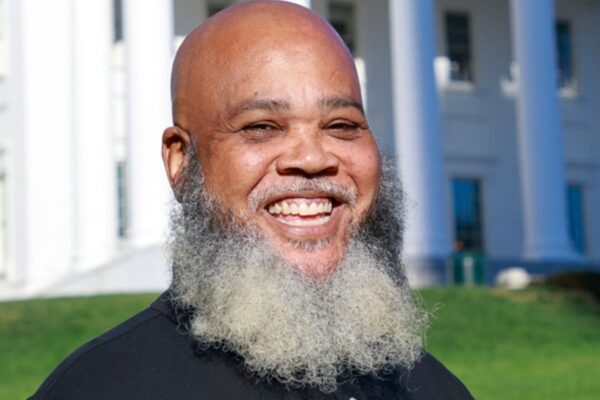
“It has been a long process over 37 years,” said Mr. King, speaking about his own disenfranchisement. “I am excited for the opportunity for people to hear my voice, and that my voice is no longer silenced.”
Related Issues
Related Content
Attorney general’s office fails to effectively implement historic ruling that ordered the restoration of voting rights to thousands of Virginians
Thousands of disproportionately impacted Black Virginians should finally have their voting rights restored on June 1
Voter Voices: Freedom to be Tati

King v. Youngkin
Stay Informed
Sign up to be the first to hear about how to take action.
By completing this form, I agree to receive occasional emails per the terms of the ACLU’s privacy statement.
By completing this form, I agree to receive occasional emails per the terms of the ACLU’s privacy statement.